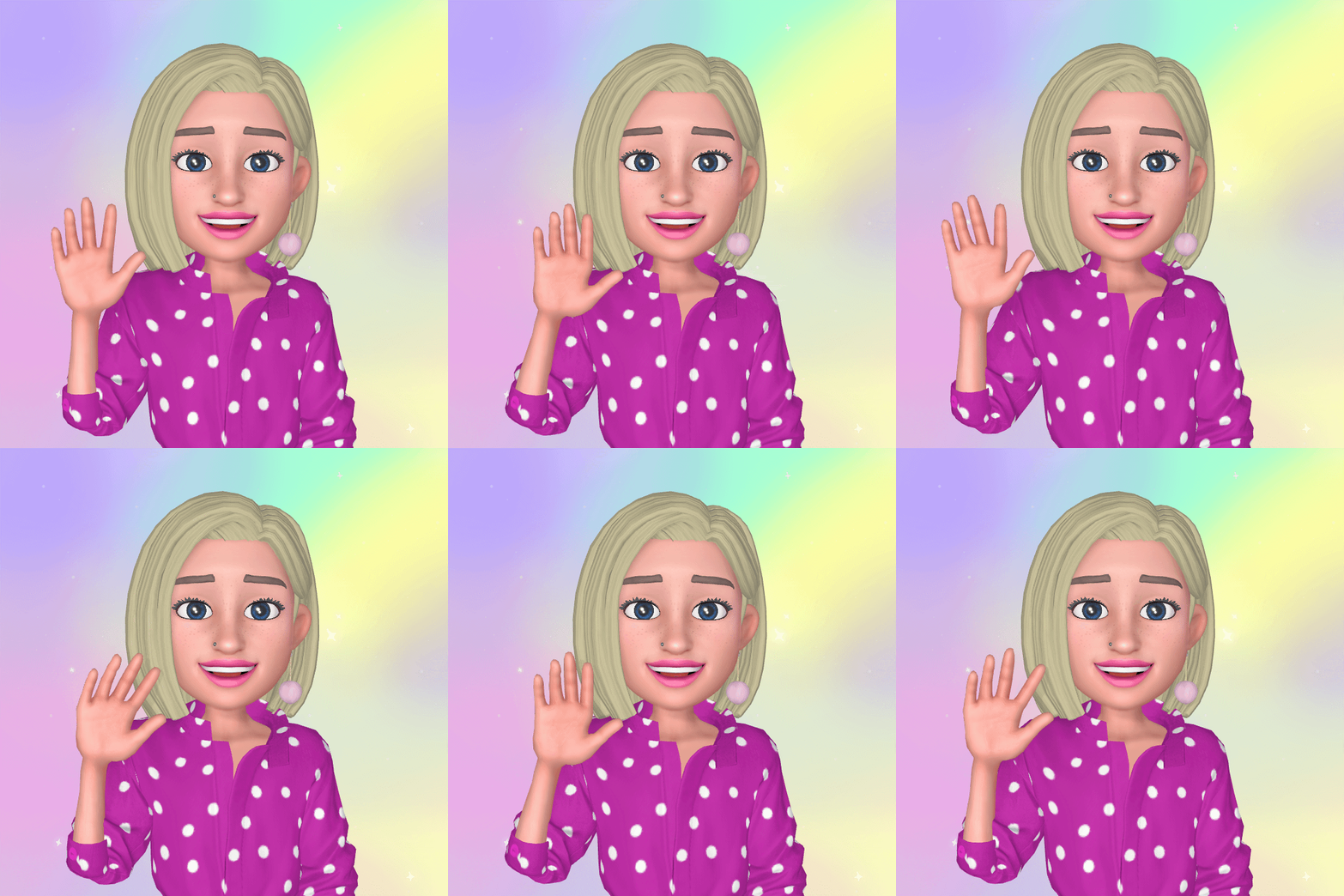
Meet The Fun Speechie 🎮✨
I'm Caitlyn — speech pathologist, professional chatterbox, lifelong nerd and firm believer that therapy should actually be fun.
If you had asked my school teachers what I would grow up to do, I'm not sure speech pathology would have been their first guess.
I was that kid who talked. A lot.
Pretty much every school report came with some variation of:
“Caitlyn would do better at school if she stopped talking so much.”
So I like to joke that one day I'd love to track down all my old teachers and show them that I actually made a career out of talking!
But perhaps they accidentally spotted something important about me.
I've always loved communication.
I've always loved children.
And I've always loved helping people.
I grew up in a family where caring for others was part of everyday life. My mum is a nurse and my sister is a mental health social worker, so helping people has always felt very natural to me.
Speech pathology turned out to be the perfect combination of everything I love.
And years later, I still genuinely love coming to work.
There is something pretty special about hearing a child say something they couldn't say before, watching a young person realise “I can actually do this!”, or seeing a family notice a change that makes everyday life just a little bit easier.
I'm The Fun Speechie for a reason.
I don't think speech therapy needs to feel like work.
Actually, I think learning is much more powerful when you're having fun doing it.
That's why I don't have one “Caitlyn way” of doing therapy.
I might have a clear therapeutic goal, but I'm going to get creative about how we reach it.
That might mean...
🎮 Turning therapy into a video game challenge
🐉 Creating a Dungeons & Dragons campaign
🎨 Making a comic book
🕵️ Solving a mystery
📚 Writing stories about your child's favourite characters
📱 Using technology and AAC
🎲 Playing games
🦄 Building therapy around unicorns, dogs, superheroes or whatever your child is currently obsessed with.
The activity might look completely different from one child to the next.
The goal stays the same. The way we get there can change.
That's one of the things I love most about being a speech pathologist — taking something that a child finds difficult and finding a way to make it interesting enough that they want to keep trying.
Because when a child is engaged, curious and having fun, therapy doesn't have to feel like therapy.
It can just feel like play, an adventure, a challenge or a game.
And that's when some pretty amazing learning can happen.
Yes... I really do love gaming. 🎮
If your child loves gaming, there is a very good chance we'll have something to talk about.
I genuinely love video games and spend time gaming with my sister. I love the creativity, problem-solving, storytelling and challenge that comes with games — and I love that gaming gives me an instant way to connect with young people.
It also means I'm completely happy to have a conversation about the game your child is obsessed with.
Minecraft?
Yep.
Pokémon?
Absolutely.
Fortnite?
Let's hear about it.
Roblox?
Tell me everything.
And if you want to explain your favourite character, strategy, lore or game mechanics to me for the next ten minutes?
I'm listening.
Gaming isn't just something I do outside of work. It has taught me a lot about how children and teenagers engage, solve problems, communicate and learn.
Sometimes the best way to connect with a young person isn't to ask them to enter our world.
It's to enter theirs.
And yes... I'm a big nerd. 🤓
Gaming isn't my only nerdy obsession.
I'm a huge Star Wars and Marvel fan, love anime, love books and am always happy to get completely invested in a fictional universe.
I think being a bit of a nerd is actually one of my greatest strengths as a speech pathologist.
Because I don't expect children to leave their interests at the door.
Their interests are often the doorway.
The things a child loves can tell us so much about how to connect with them, motivate them and make learning meaningful.
So if your child would rather talk about Pokémon than practice speech sounds, I'm not going to fight that.
I'll probably find a way to practise the speech sounds through Pokémon.
I want therapy to fit the child — not the other way around.
Every child who walks through my door is different.
Some children love games. Some want to move. Some need technology. Some want to draw. Some want to talk. Some don't want to talk at all.
Some have had wonderful experiences with therapy.
And some have already decided that they hate speech therapy.
That's okay.
My job isn't to make a child fit into my therapy style.
My job is to find a way for therapy to fit them.
I'm warm, bubbly, playful and probably a little bit silly. I'm happy to follow a child's lead, change direction when something isn't working and try something completely different when I need to.
Because sometimes the thing that finally helps a child engage isn't another technique.
It's finding the right way in.
Communication shouldn't mean changing who you are.
I believe everyone deserves to feel comfortable being themselves.
That includes children and young people who communicate, learn, play or experience the world differently.
My approach is neurodiversity-affirming because I don't believe therapy should be about teaching someone to hide who they are or making them appear more “typical.”
I want the people I work with to develop the communication skills and strategies they need to participate in the world, advocate for themselves and connect with others without having to become someone they're not.
Your child's differences aren't something I want to erase.
They're part of who they are.
I come into your child's world.
I'm a mobile speech pathologist, which means I get to work with children and young people in the environments where communication actually happens.
Home.
School.
Play.
Family life.
Everyday routines.
Real conversations.
I love this because it helps me understand the person behind the assessment scores.
I can see what communication looks like when your child is comfortable, excited, overwhelmed, playing with a sibling, talking to a friend or trying to complete a tricky task.
And then we can use those real experiences to shape therapy.
Because ultimately, the goal isn't to be brilliant at speech therapy.
The goal is to make everyday communication easier.
And parents? You're part of the team.
I might bring the clinical knowledge, but you are your child's biggest teacher.
You know your child better than anyone.
You're there for the everyday moments where communication happens — in the car, at dinner, getting ready for school, playing with siblings, reading a book or chatting before bed.
That's why I don't want therapy to become another huge task on your already busy schedule.
I'm not interested in sending you home with a stack of worksheets that sits untouched on the kitchen bench.
Instead, I prefer small, practical strategies that can fit into real life — often things that take five minutes or less.
We'll work together, celebrate what's working, change what's not, and make therapy something that feels manageable for the whole family.
Because when we're working together, those little moments between sessions can make a huge difference.
A little more about me...
When I'm not being The Fun Speechie, you'll probably find me with my family.
I'm a mum to a daughter in Grade 7 and a very proud owner of Frankie, my cocker spaniel — who is probably considerably more spoiled than she needs to be.
I love travelling, theme parks, books, gaming, coffee and spending time with my family, who I'm very close with.
One of my current favourite things to do right now is to watch horror movies with my daughter.
I'm also the person who is probably going to say something silly just to make someone laugh.
Life is too short to take everything seriously.
And I think therapy can be the same.
So, what can you expect from The Fun Speechie?
You can expect therapy that is:
🎯 Goal-focused
We know what we're working towards and why it matters.
🧠 Evidence-informed
Fun doesn't mean that therapy isn't purposeful. Behind every game, activity and adventure is a reason we're doing it.
🎮 Creative
I'll use your child's interests to make learning meaningful.
🌱 Neurodiversity-affirming
We work with your child's strengths and support them to communicate as themselves.
🏡 Real-world focused
We're working towards skills that actually make a difference in everyday life.
💛 Collaborative
You and your child are part of the team, not just people attending therapy.
✨ And, most importantly... fun.
Because I want your child to finish a session thinking:
“That was fun!”
And for you to think:
“I can't believe they were doing therapy.”
That's The Fun Speechie.